
Blog
Pick-to-Light vs Traditional Picking: Improving Speed and Accuracy in Warehouse Operations

Why Warehouse Picking Methods Matter More Than Ever
Order picking is one of the most labour-intensive and time-consuming activities in any warehouse. In many operations, it accounts for the majority of daily labour hours and has a direct impact on order accuracy, throughput, and customer satisfaction.
As order volumes grow and SKU counts increase, even small inefficiencies start to compound. Extra steps, brief pauses to search for items, or minor picking errors may seem insignificant in isolation — but across hundreds or thousands of picks per day, they quickly add up to lost time and higher operating costs.
Many warehouses continue to rely on traditional picking methods simply because they’ve “always worked.” But rising labour costs, tighter delivery expectations, and increased pressure for accuracy are forcing operators to take a closer look at whether their current approach is still the most efficient fit.
This is where the comparison between traditional picking and pick-to-light systems becomes important — not as a one-size-fits-all answer, but as a way to understand which method best supports different workflows and operational demands.
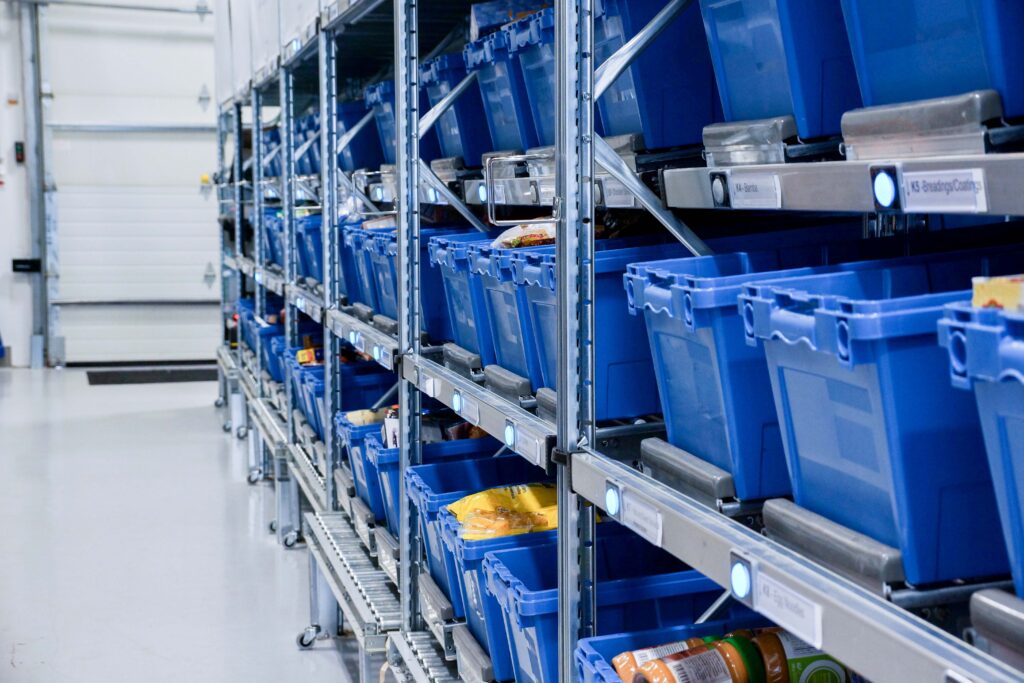
Traditional Manual Warehouse Picking
Traditional picking methods are the backbone of most warehouses. These include pick-to-paper, RF scanning, and simple visual/manual picking from shelves or racks. They rely heavily on human memory, attention to detail, and familiarity with the warehouse layout.
For smaller operations or warehouses with low order volumes, traditional picking works well. Pickers can navigate aisles efficiently, and errors are manageable. Training new staff is straightforward, and the cost of implementation is low compared to automated systems.
However, traditional picking starts to show its limits as operations scale. Common challenges include:
-
Increased picking errors: Human fatigue and distractions cause mistakes that slow down throughput or lead to returns.
-
Longer training times: New staff take longer to reach full efficiency, especially in complex warehouses.
-
Slower picking speed: Pickers must search visually for items, check labels, and confirm quantities, adding seconds to each pick that multiply across large orders.
-
Scaling headcount instead of efficiency: Adding more staff to maintain output increases labour costs without addressing underlying inefficiencies.
Traditional picking isn’t outdated or “wrong” — it simply has limitations when accuracy, speed, and scale become critical. Recognizing these limitations is the first step in understanding when a pick-to-light system might make a significant difference in your warehouse workflow.
Pick-to-Light Explained: How LightPick Transforms Warehouse Picking
Pick-to-light is a light-guided picking system that tells pickers exactly where to go and what to pick.
With a system like LightPick, each pick location is fitted with a small pick module. When an order is released, the correct locations light up and display the quantity to pick.
Here’s what the workflow looks like:
-
The picker starts the order (often by scanning a barcode or pressing a button)
-
Lights guide the picker to the correct aisle and shelf
-
A display shows the quantity to pick
-
The picker takes the item and confirms the pick with a button press
-
The system updates the order automatically and moves to the next location
Because the instructions are visual and immediate, pick-to-light reduces errors and speeds up picking, especially in environments with high order volume or repetitive SKUs. New employees can become productive quickly because the system shows them exactly what to do.
Pick-to-light works best when paired with organized, fixed pick locations — such as modular shelving or flow-through storage where items are consistently stored in the same place. In these setups, it actively improves the overall workflow.
Compared to traditional picking, pick-to-light removes unnecessary steps and decision-making, helping warehouses handle more orders with greater accuracy — without adding more labor.
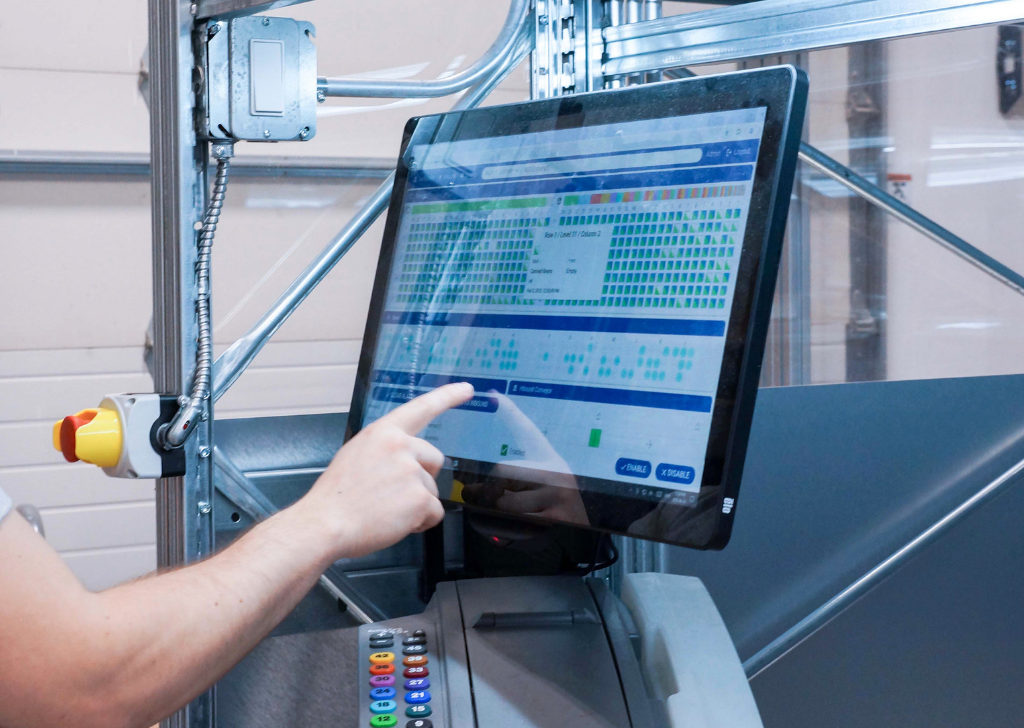
Pick-to-Light vs Traditional Picking: Choosing the Right System for Your Warehouse Picking
Comparing pick-to-light with traditional picking isn’t about declaring one method “better” — it’s about understanding which works best in different warehouse environments.
Traditional picking relies on paper lists, handheld devices, or visual memory. Pickers have to locate items themselves, confirm quantities manually, and update records after the fact. This method works well for smaller warehouses, low volumes, or irregular SKUs. But as order volumes grow, errors and delays become more frequent. Searching for items, double-checking quantities, and training new staff can slow operations and increase labor costs.
Pick-to-light, on the other hand, guides pickers with lights and numeric displays. It shows exactly where to pick and how many units, and confirms picks in real time through the system. This reduces human error, speeds up picking, and allows new staff to become productive quickly. Repetitive orders, high-volume SKUs, and tight accuracy requirements are where pick-to-light shines.
That said, pick-to-light isn’t perfect for every situation. It works best when items are consistently stored in the same locations. Large, irregularly shaped items or constantly changing inventory layouts may still be better suited for traditional picking methods.
The key takeaway: the right picking method depends on your workflow, order volume, and storage setup. Pick-to-light removes inefficiencies where speed and accuracy are critical, but traditional picking can still make sense in lower-volume or more flexible environments. By understanding the strengths and limitations of each method, you can make operational decisions that improve throughput and reduce errors — without overcomplicating your warehouse.
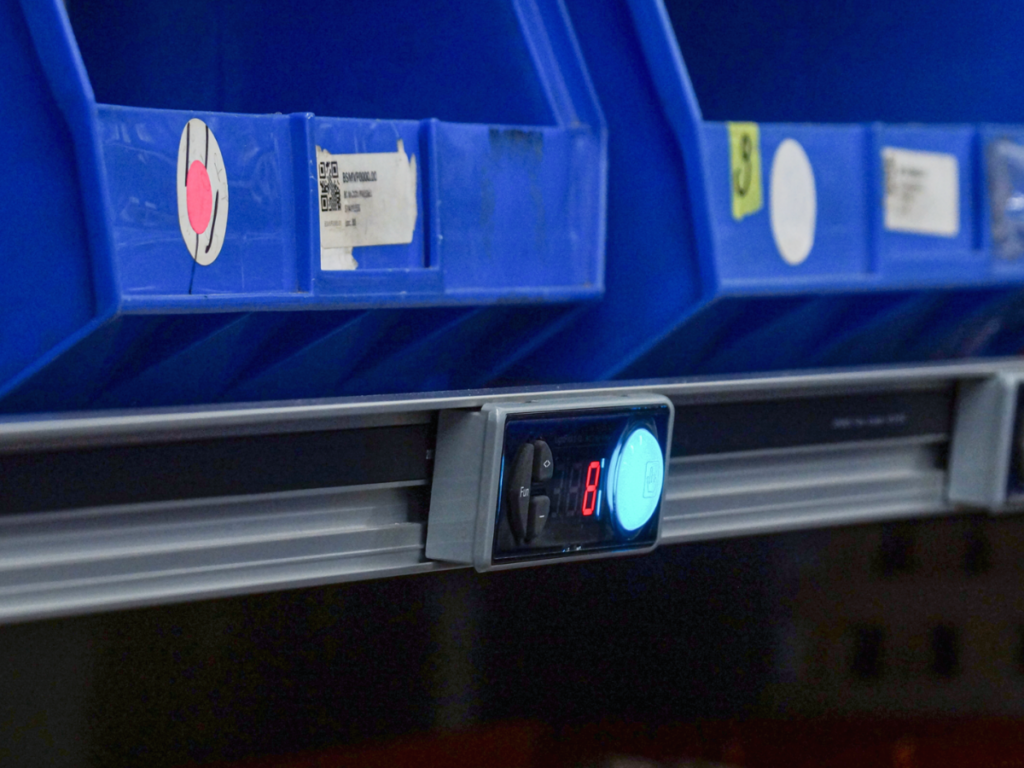
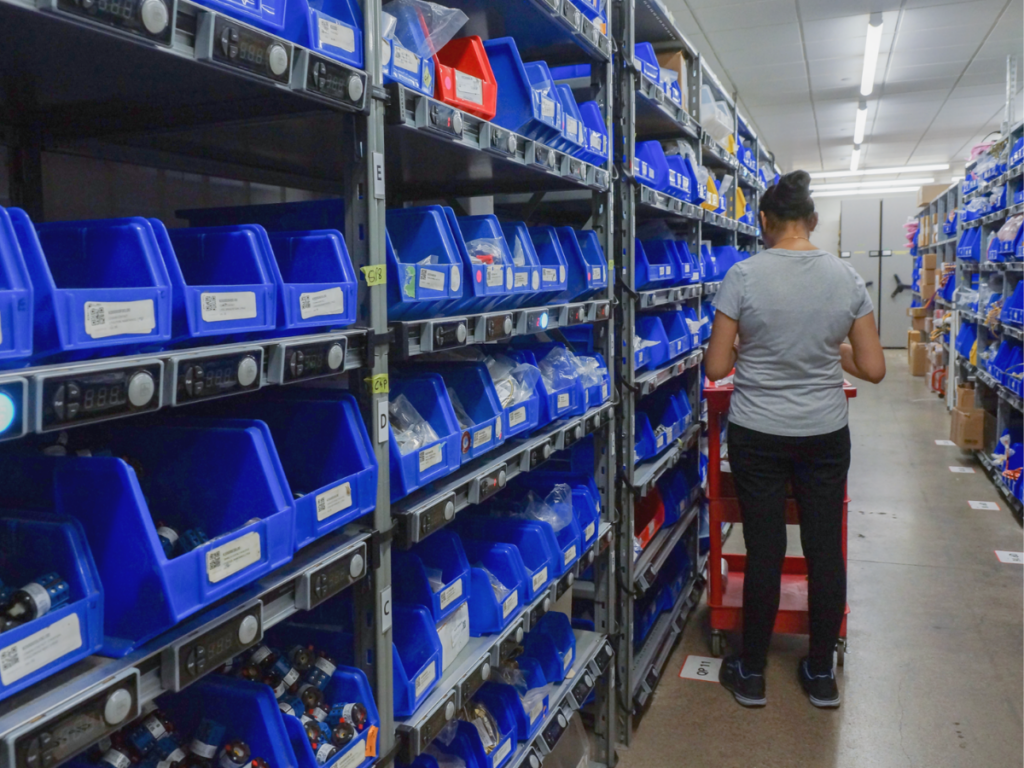
How Storage Design Supports Light Pick for Faster, More Accurate Warehouse Picking
Pick-to-light is only as effective as the storage system behind it. Even the best light-directed technology can’t overcome poor layout, disorganized shelving, or inconsistent slotting. A thoughtfully designed storage system ensures that pickers can follow the lights efficiently — reducing travel, eliminating errors, and maximizing throughput.
Key elements that support pick-to-light include:
-
Organized shelving layouts: Items are consistently stored in fixed locations so lights can accurately guide pickers.
-
Modular shelving and flow racks: Flexible systems allow you to adjust pick locations as inventory changes, keeping the workflow efficient.
-
Clearly labeled bins and slots: Reduces confusion and ensures the system and staff remain aligned.
-
Proper aisle widths and pick zones: Optimized travel paths let pickers move smoothly from one pick location to the next.
When the storage system and pick-to-light work together, the results are faster picking, fewer errors, easier training, and the ability to scale operations without adding headcount.
Need help figuring out what works best for your warehouse?
Our team offers free site visits and professional recommendations. We’ll help you determine the optimal storage layout, shelving solutions, and picking method for your specific operation — ensuring your pick-to-light system delivers maximum efficiency.
Call us today: 905.497.6497 | Toll Free: 1.855.497.7463
Talk to us about how to apply this system to your space — we will show you the difference.
At ShelvingMate, we offer a wide range of storage solutions, including pallet racking, mezzanine systems, catwalks, different types of shelving, lifts, and automation technologies like Rover ASRS, 4D Pallet Shuttle, Conveyors, Semi-Automatic Shuttle, and Pick-to-Light systems. Whether you’re optimizing warehouse space or enhancing organization, we have the right solution for your needs.